The Content Assets That Actually Close Deals
Jonas Ander · 2026-01-27
Which content assets actually help close B2B deals? Insights from KontentPlus’ first year, highlighting the sales content formats that accelerate revenue.
In our first year at KontentPlus, we noticed a clear pattern: a small number of content assets consistently help sales teams move deals forward. The rest may build awareness, but rarely influence revenue outcomes. Below is what we’ve learned so far, and how it aligns with what current research is showing.
From “More Content” to “Right Content”
Most B2B companies produce more content than ever. Yet sales cycles remain long, and sales teams still rebuild decks and emails from scratch. The core lesson is simple: Volume does not equal velocity.
High-performing sales teams consistently ask for:
Fewer, sharper assets
Clear relevance to a specific buyer role and deal stage
Content they can actually use in meetings and follow-ups
Research supports this. Industry data shows that a majority of B2B content assets go unused, while targeted, relevant content – designed for specific buyer needs and moments – is far more likely to be consumed and impactful (Demand Exchange).
When content is built for these conditions, it stops being “marketing collateral” and starts functioning as a true sales instrument.
The Five Content Assets That Consistently Accelerate Deals
Across industries, deal sizes, and sales models, five asset types repeatedly proved decisive in helping sales teams progress and close deals faster.
1. Buyer-Specific One-Pagers
The most effective sales asset is rarely the most comprehensive, it’s the most precise.
High-performing one-pagers focus on:
One buyer role
One dominant pain point
One clear outcome
When done well, they shorten time-to-understanding and remove early friction in sales conversations. This aligns with research showing that relevance to buyer context and decision stage is a key driver of engagement (Demand Exchange).
2. Sales-Driven Case Stories
Traditional case studies are often written to impress. Sales-driven case stories are designed to reduce perceived risk.
They focus on:
The buyer’s starting point
The decision moment
Tangible business outcomes, not feature lists
These assets are most effective mid-funnel, when buyers are comparing vendors, and in internal stakeholder sharing, where the message must stand on its own without a salesperson present.
3. Problem-Framing Thought Leadership
Buyers commit when they accept a problem definition, and its urgency, not when they admire features.
We see stronger impact from thought leadership that reframes industry inefficiencies, hidden costs, and strategic risks
This type of content helps align stakeholders around why change is necessary, creating momentum before product discussions even begin.
4. Interactive and Visual Explainers
Many of our clients sell complex solutions that don’t translate well into bullet points or one-liners. When complexity isn’t explained clearly and consistently, decision-making slows.
High-performing formats include:
Visual process maps
Short explainer decks
Simple diagrams that show how it works
Across industries, practitioners increasingly point to visual and interactive formats – such as webinars, product demos, and visual maps – as especially effective for driving clarity and engagement throughout the buying journey.
We also see strong results from repurposing existing webinars and investor presentations into short, focused explainer videos tailored to specific audiences or use cases.
5. Modular Content Libraries Integrated with Sales Tools
The final insight is operational. Even excellent content fails if it is: hard to find, poorly organized, and detached from sales workflows and tools.
The most effective organizations treat content as a living system - continuously updated, measured, and aligned with active sales motions. This mirrors industry research showing that content operations and measurement fundamentals are essential to sales impact.
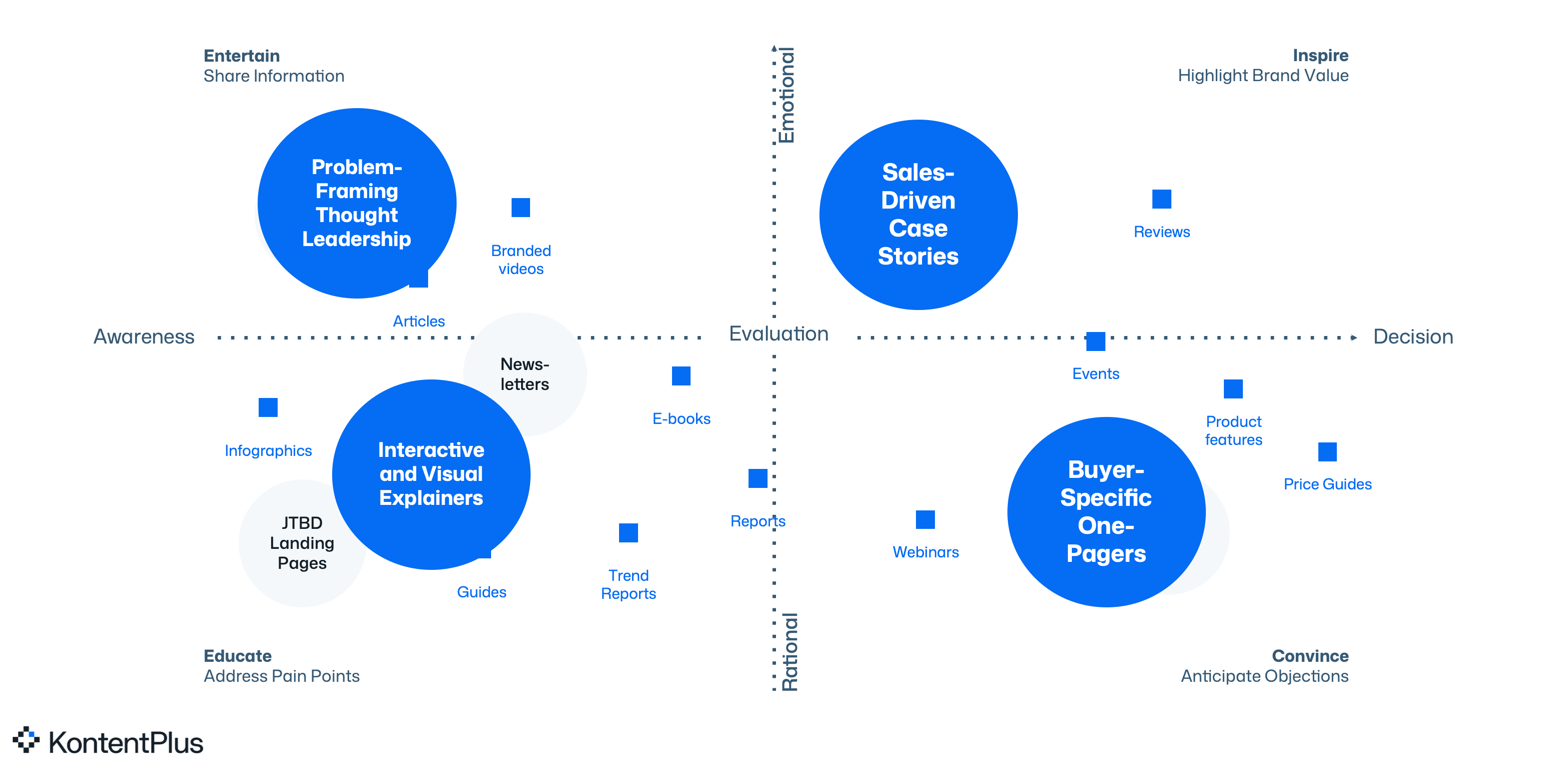
Content assets that accelerate deals.
Why These Assets Work: Three First-Year Learnings
After a year of close collaboration with B2B sales and marketing leaders, three principles now guide how we build content for revenue impact.
1. Sales Content Is Contextual, Not Universal
Effective assets adapt to:
Buyer role
Industry
Region
Deal stage
One-size-fits-all content consistently underperforms in complex buying environments.
2. Speed Beats Perfection
Deals accelerate when sales teams can access – or even produce – relevant content instantly.
AI-supported workflows allow teams to maintain quality while dramatically improving speed-to-market. Both our client work and industry research show that timeliness and personalization correlate strongly with engagement.
3. Measurability Changes Behavior
When teams can see which assets influence meetings, progression, and close rates, content strategy shifts from opinion-based to performance-driven.
This move – from creation to continuous optimization – is how modern revenue teams extract real business value from content.
Content as a Revenue Asset
After our first year, one conclusion stands out:
Content that shortens sales cycles isn’t just created - it’s engineered.
It requires:
Strategic alignment between sales and marketing
Systems that scale relevance without sacrificing quality
A continuous feedback loop between performance and production
At KontentPlus, this insight underpins everything we do – and will continue to shape how B2B organizations turn content into closed deals.
A Note on Scope and Maturity
These insights are based on our first year and roughly 15 projects. That’s enough to reveal strong patterns, but not enough to claim statistical certainty. We treat this as early signal and expect our conclusions to sharpen – or be challenged – as our dataset grows.