Marketing Without a CMO: A Content Operating Model
Jonas Ander · 2026-01-19
A lean content operating model for B2B teams without a CMO, focused on structure over campaigns and content that actually supports sales.
Most marketing models are built for organizations with a CMO, a full team, and time to plan. They assume campaign cycles, specialist roles, clean handoffs, and clear ownership. That’s not how many B2B companies actually operate. Below is a practical way to structure marketing and sales -supporting content in organizations without a large marketing team or a dedicated CMO - while still keeping things consistent, useful, and tied to commercial outcomes.
In many B2B companies, marketing doesn’t fail in obvious ways. It slowly loses its shape.
Content gets produced. Decks are updated. Posts are published. But over time, it becomes harder to explain how it all connects to revenue - or even why certain initiatives exist.
Having worked both as a CMO and as an advisor to fast-growing companies without one, a pattern shows up again and again:
In organizations with a CMO and a well-resourced team, coherence is usually built into the system. There’s a shared story, clear ownership, and an operating logic that connects brand, demand, sales support, and growth. Not because everything is perfect, but because someone is responsible for keeping things aligned over time.
In companies without that role, marketing rarely stops. Instead, it fragments.
Responsibilities are spread out. Priorities shift quickly. Marketing is expected to support sales, build credibility, generate leads, help partners, and stay consistent - all at the same time. Given limited headcount and constant commercial pressure, that’s entirely reasonable.
The problem is that most marketing operating models assume scale. When those assumptions don’t hold, the model breaks.
With limited resources, marketing can’t rely on big campaigns, complex workflows, or strict role definitions. It needs a structure that works despite context switching, shared ownership, and lack of time - one that keeps narrative, content, and sales support connected even when no single person “owns” marketing in the classic sense.
The Shift: From Campaigns to Content Infrastructure
Traditional marketing planning revolves around campaigns. They’re easy to plan, easy to name, and easy to move on from. The downside is that they don’t leave much behind. When a campaign ends, much of the content tied to it quietly stops being used.
For lean organizations, that’s a poor return on effort.
A more durable approach is to think in terms of content infrastructure: content that’s built to be reused, referenced, and improved over time. Instead of asking how to promote a message, the question becomes how to make that message consistently available to sales, leadership, and the rest of the organization.
This isn’t about producing more content. It’s about making the content you do create easier to use - and harder to lose track of.
At KontentPlus, this way of working is supported by a bespoke AI infrastructure that acts as the backbone for content production. It’s not a static system. It’s continuously updated with internal interviews, real customer conversations, feedback from sales, and performance data from channels and content in use. The goal isn’t automation for its own sake, but a living foundation that keeps content grounded in reality as the business evolves.
A Simple 4-Layer Content Operating Model
The model below is intentionally straightforward. It assumes limited resources, shared responsibility, and a strong need to stay aligned with sales.
1. Strategic Narrative
Everything starts with a clear narrative: who you’re for, which problems you focus on, and what makes your approach different. This layer should change slowly, if at all. Its job isn’t to inspire creativity, but to set boundaries.
When the narrative is clear, content decisions get easier. You can quickly tell whether something strengthens your position or just adds noise. That matters even more when content is created by different people over time.
In most cases, this narrative should be jointly owned by leadership and sales. Not because marketing shouldn’t be involved, but because it needs to reflect real customer conversations - not just internal assumptions.
2. Sales-Critical Content
Before worrying about channels or visibility, marketing should make sure sales has what it needs to run good, consistent conversations.
That usually means a limited set of core assets: a main pitch, clear explanations of the solution, material that addresses common objections, and credible proof points.
These assets matter because they’re used repeatedly, in real situations. Feedback from sales is immediate and concrete, which makes improvement faster and more grounded.
If content isn’t making sales conversations better, it’s usually a sign that priorities are off.
3. Modular Content
Once the foundations are in place, scale comes from reuse rather than constant invention.
Instead of creating separate content for every channel, the same ideas are expressed in different formats depending on context. One well-thought-through insight can support a blog post, a LinkedIn update, a slide, or a short sales email.
This isn’t just about efficiency. It’s about consistency. Over time, repeated exposure to the same ideas strengthens your position instead of diluting it.
It also makes content production more predictable and less dependent on coming up with something “new” every week.
4. Lightweight Governance
Operating without a CMO still requires someone to keep things pointed in the same direction. What matters is that ownership of the narrative is clear, priorities are understood, and outdated or misleading content is actively removed.
Governance here is about maintaining clarity. When direction is clear, teams can move faster with less coordination overhead.
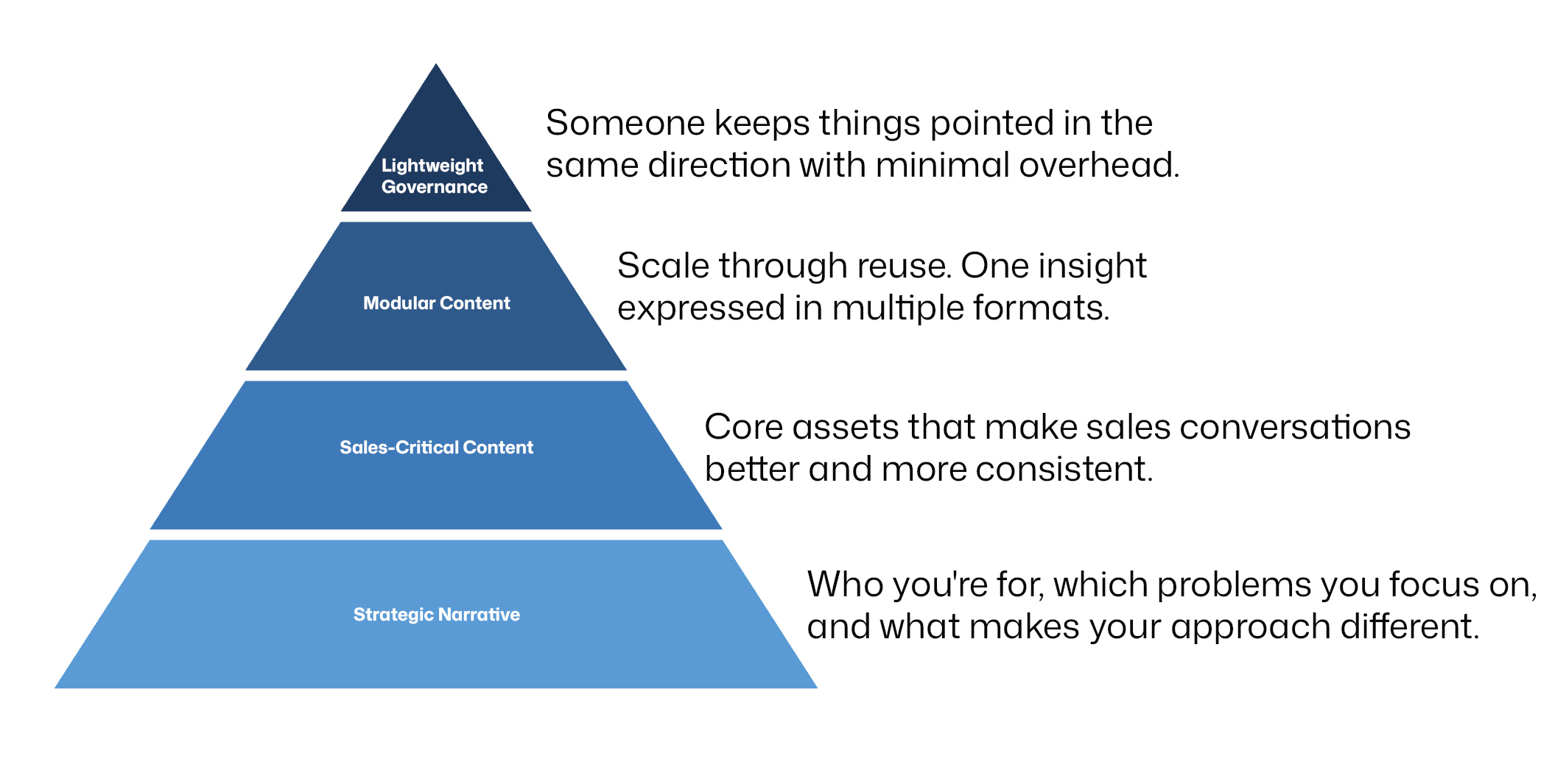
4-Layer Content Operating Model
Why This Holds Up Over Time
This model doesn’t depend on job titles or organizational maturity. It works with small teams, external contributors, and shifting responsibilities because it’s built around structure, not hierarchy.
It also changes the internal conversation. Instead of debating which channel to focus on or what to post next, teams start asking which content actually helps sales and strengthens positioning.
Marketing Maturity is about structure
Effective marketing doesn’t require a large team or a perfect org chart. It requires clarity about what matters, discipline in what gets produced, and systems that make good decisions repeatable.
Marketing maturity isn’t about scale - it’s about structure. And that is something even lean organizations can build deliberately.
–
Jonas Ander